A performance created for Analog Futures, Well College, String Room Gallery, September 1, 2016. Bernagozzi is performing with a color wobbulator of his own construction.
Analog Futures

Video Still: Jason Bernagozzi, Cathodic Vernacular (2016)
Analog Futures
September 1 – October 14, 2016
Opening Reception: September 1, 6:00 – 8:00 p.m.
The String Room Gallery
Wells College
Aurora, NY
https://www.wells.edu/string-room-gallery
Featuring work by Brandon Barr, Jason Bernagozzi, LoVid, and Aldo Tambellini. Curated by Laura McGough
Opening Reception will include a curator’s talk at 7:30 followed by a performance by Jason Bernagozzi
Analog Futures brings together work by artists who explore the materiality of the machines and electronic devices that deliver images and information to us. In Analog Futures, television sets and computer black boxes, cathode ray tubes and VHS videotape, are transformed into sculptural objects, repurposed and reanimated to reveal the internal electronics that power video monitors, the visual glitches that underlie computer circuitry, and the magnetic tape that mysteriously holds video imagery.
MEDIA DIALECTS & STAGES OF ACCESS at Squeaky Wheel’s 30th Anniversary Closing Celebration and Conference
I’ll be moderating a panel at Squeaky Wheel’s 30th Anniversary Closing Celebration and Conference on Saturday May 14 at 3:30 at the Burchfield-Penney Art Center, Buffalo State College. This multi-media conference celebrates Squeaky Wheel’s former and current programs, artists, scholars, and community members.
MEDIA DIALECTS & STAGES OF ACCESS
Panel Members
Laura McGough (moderator)
Ron Ehmke
Chris Hill
Barbara Lattanzi
Taking its title from Chris Hill and Barbara Lattanzi’s 1992 article of the same name, this panel will critically examine the lively and highly productive public access television scene that emerged from within the Buffalo arts community in the late 1980s and early 1990s. Drawing from their experiences as both active public access producers and innovative media curators, in “Media Dialects and Stages of Access,” Hill and Lattanzi offered an extensive survey of public access programming produced by artists nationwide. Framing public access programing, “…as a public stage, as a stimulus to regionally specific and culturally-diverse video dialects and as crucial to the construction of an active audience,” they revealed the wildly inventive range of interactive media strategies that artists developed to engage in a direct and intimate dialogue with local audiences. The ideas introduced in “Media Dialects and Stages of Access,” will serve as a jumping-off point for our conversation as we seek to place a past history of local public access production in conversation with the present.

Barbara Lattanzi, Chris Hill, Laura McGough, Ron Ehmke (l to r)
“Cut Piece With Transgender Body (After Yoko Ono)”
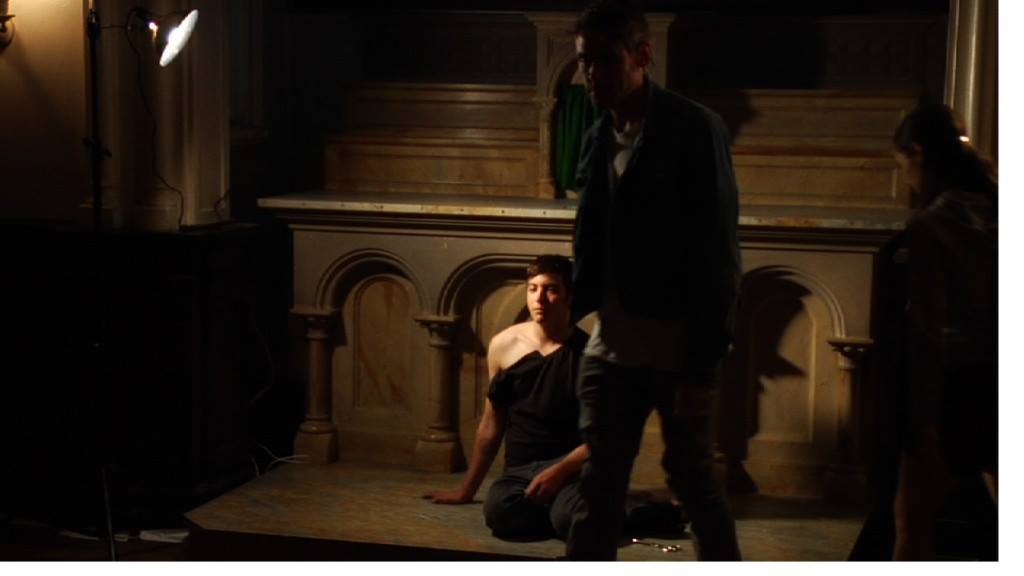
“Cut Piece With Transgender Body (After Yoko Ono)” by Jaimes Mayhew will be streaming live on March 22 at 6:20 pm at Cranbrook Academy of Art. Trans-identified docents will cut the clothes away from Jaimes Mayhew’s body following commands submitted by viewers via live chat.
Docents who will be performing this work are: Rahne Alexander, Asa Keiswetter, Jack Pinder and Samy Hayder.
This work is presented by the Critical Studies program at Cranbrook Academy of Art.
Critical Studies Lecture: Cranbrook Academy of Art
“Likes and Dislikes: Reading the Paratextual Apparatus of Participatory Media”and Live Streaming Performance
Cranbrook Academy of Art
March 22, 2016 at 6:00 pm
Literary theorists refer to the formal elements that accompany the main text of a written work —illustrations, title-pages, appendices and footnotes — as the paratextual apparatus. Conceived as a “threshold,” “vestibule,” or “zone of “transaction,” paratextual elements are semiotically active components that exert an influence on the reader, working strategically to provide clues or signals that guide them towards a specific interpretation of a text. From likes and dislikes to annotations embedded in audio streams, the paratextual apparatus of Web 2.0 likewise, supports a legion of elements that guide our reception of new media objects. In this lecture, we will critically read the
paratextual apparatus of participatory media through YouTube videos, Soundcloud streams, Hulu ads, and other online content to understand how the interactive and shifting nature of these framing devices influence our understanding of new media objects.
As a conclusion to our year-long investigation into participatory media, this lecture will be followed by Cut Piece With Transgender Body (After Yoko Ono), an interactive streaming performance by Jaimes Mayhew. Mayhew will perform a rendition of Yoko Ono’s famous performance, Cut Piece that invites viewers to send text instructions which will be carried out by a group of transgender docents. This performance will last for approximately 45 minutes.
Lecture: Television and Transmissions: Towards a Partial History of the Live Transmission
April 12, 2016
Alfred University
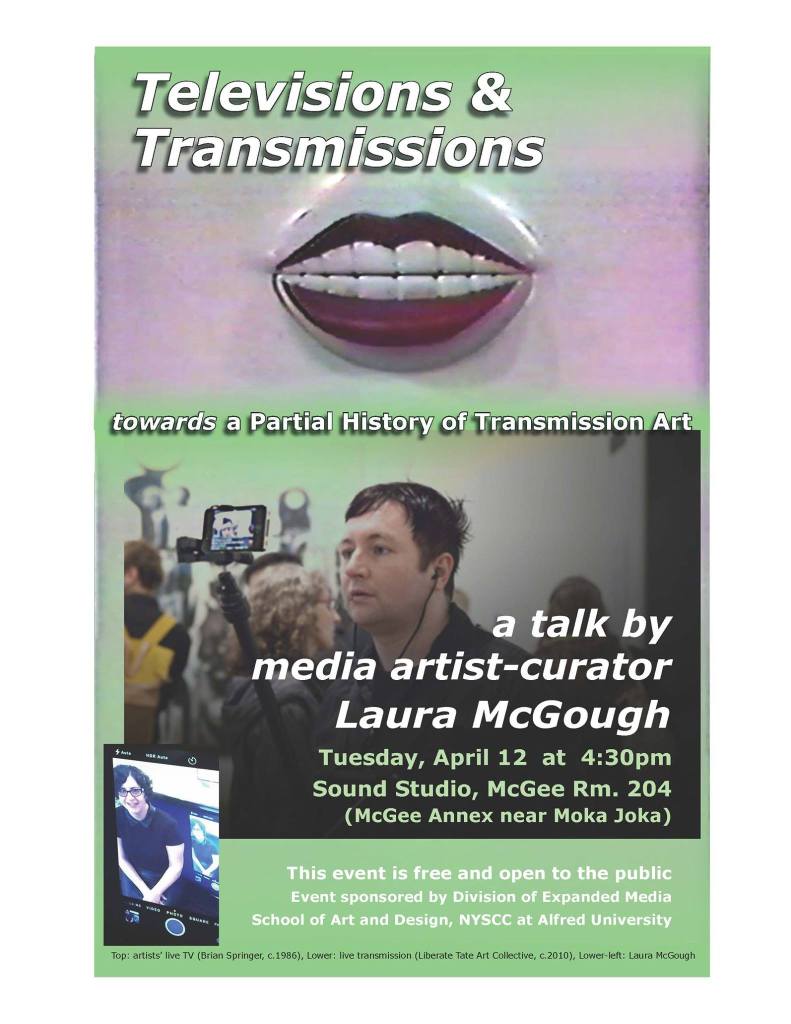
In his seminal essay “Video The Distinctive Features of The Medium,” David Antin asserted, “…it is with television we have to begin to consider video, because if anything has defined the formal and technical properties of the video medium it is the television industry.” Although video art has long been liberated from the television monitor, Antin’s declaration deserves further consideration. Television, and its most basic technical property, the transmission, continues to haunt media art in the Post-Internet age, a specter lurking behind, artist YouTube channels, glitch art and the rediscovery of analog video tools, but perhaps most apparent in the proliferation of live online streaming experiments. Whether appropriating social broadcasting platforms like Twitch.tv or Periscope or developing their own streaming networks, a growing number of artists are exploring the live transmission as a site for performance, intervention, dissent and audience interaction. In an era marked by video-on-demand, how do we account for this current preoccupation the live transmission?
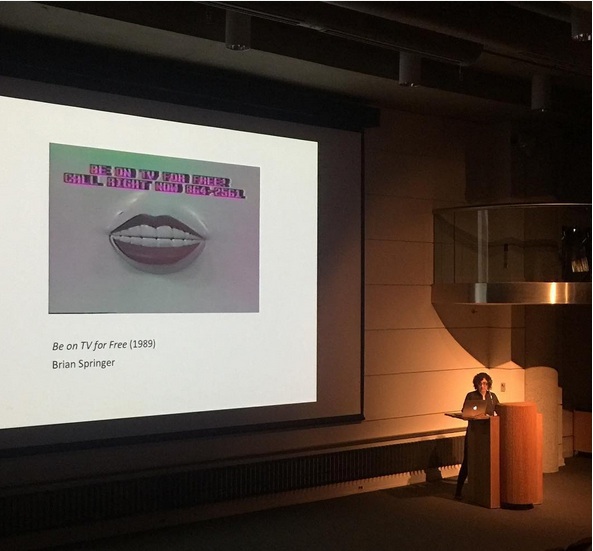
This lecture attempts to conceptualize a history of the live transmission in an effort to describe its reemergence in the Post-Internet era. From Lucio Fontana’s infamous and much contested broadcast on Italian television in 1952 to programming streamed through ESP TV, the Strobe TV and other artist-run networks, the live transmission punctuates media art history, emerging and re-emerging as a stubborn reminder of its televisual past. What leads artists to experiment with the live transmission? How does our concept of liveness change over time and how does the transmission work to both foreground and resist such shifts? What sort of aesthetic experiences might liveness offer viewers? In an effort to begin to answer some of these questions, I will critically read the live transmission in all of its diverse forms – the televisual, the closed-circuit, the streaming – to begin to make manifest a genealogy of televisions and transmissions.
Lecture: The Labor of Participation
February 9 at 6:00 pm
Cranbrook Museum of Art
Playbor, a portmanteau of “play” and “labor,” is a term used by media theorists to describe our interactions within social media spaces. While on the one hand, our participation in online environments may constitute a form of sociality, or play, it also engages us in a form of digital labor as our posts, uploads, comments and tweets become the means of production that generate content for these sites. In this lecture, we will critically read our online activity and consider what happens when we collapse work, play, and sociality into a single activity.
Sponsored by the Critical Studies and Humanities Program.
Lecture: “Digital Feelings: Participatory Media as Emotional Space“
November 3, 2015 6:00pm
Cranbrook Academy of Art
In this lecture I examine how are lurkers “moved” to become active participants in social media environments. This discussion focuses on the role of emotion within participatory media and the haptic and affective modes of experience that the digital age has inaugurated. Borrowing from theorists including Giuliana Bruno, Laura U. Marks and Sian Ngai, we will explore how participatory media forms function as emotional spaces and how the new ways of thinking, feeling, and perceiving generated by our digital interactions have permeated artistic practice.
M.C.R.R. at Squeaky Wheel Film & Media Art Center’s 30th Anniversary Exhibition
Work created as a member of the Media Coalition for Reproductive Rights (M.C.R.R.) is on view as part of Squeaky Wheel Film & Media Art Center’s “30th Anniversary Exhibition” at the Burchfield-Penney Art Center at SUNY Buffalo State from October 9, 2015–Sunday, January 24, 2016
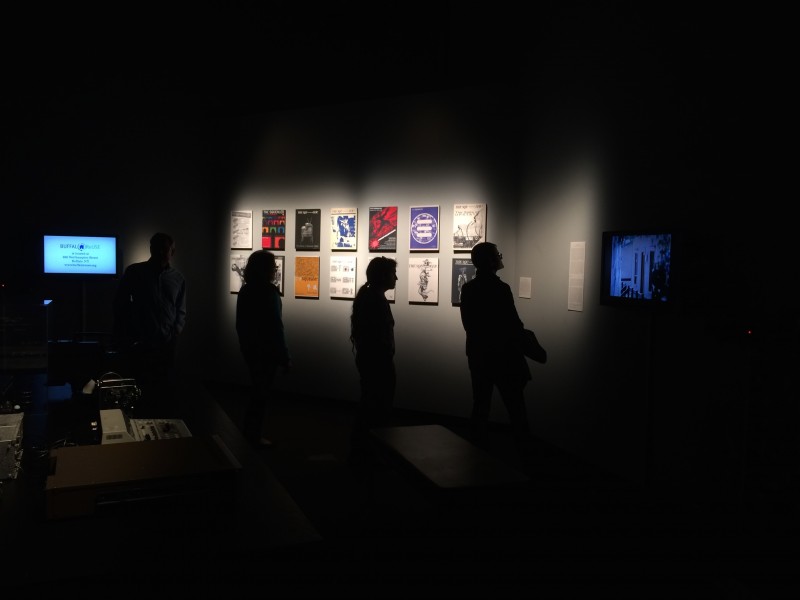
Idiomorphs: Barbara Lattanzi, Selected Works at Microscope Gallery
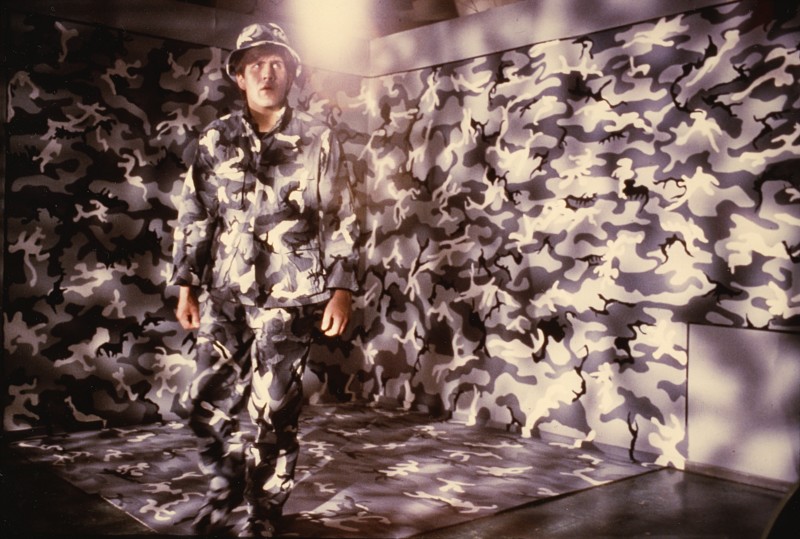
Idiomorphs: Barbara Lattanzi, selected works, will screen at the Microscope Gallery on Friday, October 16, 2015 at 7:30 p.m. Idiomorphs is a career survey of media artist Barbara Lattanzi’s film, video and generative software works and was originally presented as part of Hallwalls Contemporary Arts Center’s 40th Anniversary celebrations. For more information: http://www.microscopegallery.com/?page_id=16814
Over the course of her career, media artist Barbara Lattanzi has created a broad and influential body of screen-based work that spans across mediums—film, video, installation and interactive and generative software. Lattanzi utilizes the term “idiomorph” to characterize the diverse but interconnected projects that populate her oeuvre. Derived from the Greek idio-morphos, idiomorph alludes to a characteristic shape or individual form, enacting what Lattanzi notes is “both a position to be sought out and a process of recursively moving towards.” There is an underlying performativity operating in Lattanzi’s idiomorphs as she animates both the medium, itself, as well as the various “characters” that populate her work. In Lattanzi’s hands, filmic surface, software and pixel activate an ongoing investigate into the materiality of the mediated image, while a cast of vampires, bishops, politicians and teapots actively interrogate a range of aesthetic, art historical and political relations. Idiomorphs presents key works from Lattanzi’s career including early films, public access programming, and generative and interactive software projects—work that is at once challenging, humorous, and visually stunning.
Barbara Lattanzi’s films, videos, Internet art, and generative software works have been screened and exhibited widely, including venues such as the Ann Arbor Film Festival, Harvestworks-NYC, the European Media Art Festival, The New Museum, Squeaky Wheel-Buffalo, FILE Festival-Sao Paulo Brazil, Albright-Knox Art Gallery, and Museum of Modern Art. Her experimental software, “C-SPAN Karaoke”, received an Honorary Mention at Transmediale, the Berlin-based international media art festival. Her early “net art” work is represented in Rhizome.org “Artbase” collection, Turbulence.org, Computer Fine Arts collection, the Moscow on-line software archive “Runme.org“, and a gatepage for the “Artport” website of the Whitney Museum of American Art. Writings about Lattanzi’s work have appeared in Millenium Film Journal, Neural magazine, Cinema Video Internet: Tecnologie e avanguardia in Italia dal Futurismo alla Net.art edited by Cosetta Saba, and Internet Art by Rachel Greene, among others. She has received grants for her work from the New York State Council on the Arts, the New York Foundation for the Arts, and the Experimental Television Center. She received a BFA from the School of the Art Institute of Chicago and an MAH from the Center for Media Study of SUNY at Buffalo. While living in Buffalo, N.Y. in the 1980s, she was the video curator for Hallwalls Contemporary Arts Center. Barbara Lattanzi currently teaches in the Expanded Media Division of the School of Art and Design, Alfred University, Alfred, New York.
Laura McGough has had a diverse career as an educator, curator, critic and grants administrator, working at organizations ranging from Hallwalls Contemporary Arts Center to the National Endowment for the Arts. Along the way, she organized exhibitions, screenings, Webcasts, and performances for arts organizations in the U.S., Australia, Canada, and Europe; published critical writing on the visual arts, media arts and new media; participated in numerous local, regional, and national grants panels; and received funding from the D.C. Commission on the Arts and Humanities, the New York State Council on the Arts, the Canada Council, and the British Council to support varied curatorial initiatives. She is completing a PhD in the Department of Media Study, SUNY University at Buffalo. Laura McGough is currently the Critical Studies Fellow at Cranbrook Academy of Art.
Documentation from Microscope event. Barbara Lattanzi performing “Drawing Organ”
 Laura Spitale McGough